Jak to bylo s okupací
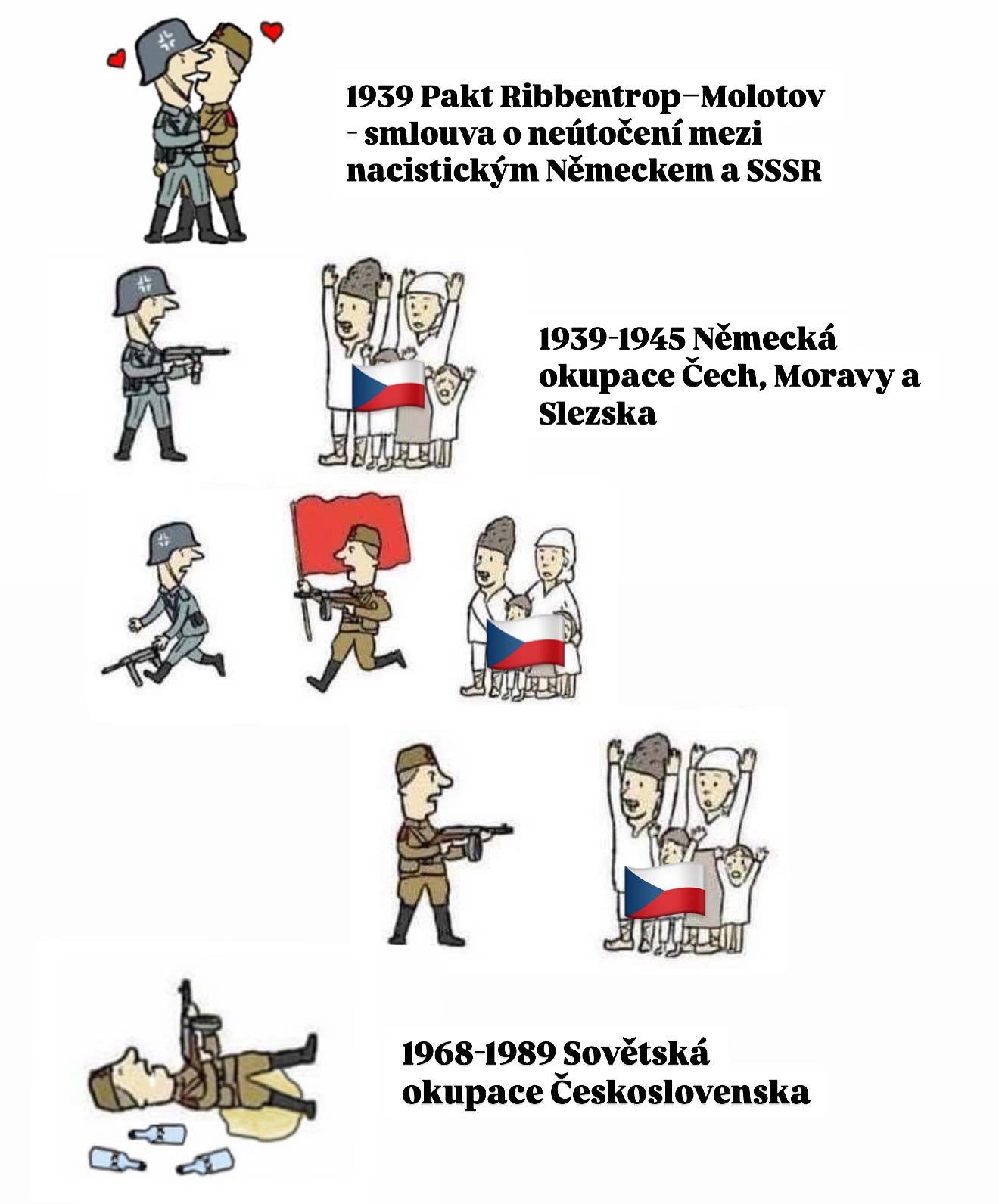
The material titled “How It Was with the Occupation” is a satirical comic that compares the actions of Nazi Germany and the Soviet Union towards the Czech lands in simple panels. It depicts, among other things, the Ribbentrop–Molotov Pact, the German occupation from 1939 to 1945, and the Soviet occupation from 1968 to 1989. A recurring motif is armed soldiers aiming at civilians with the Czech flag, hearts ironizing the alliance, and a caricature of a “drunken” soldier by bottles, creating a sharp contrast between the aggressor and the victim.
The analysis showed a broad consensus that the comic relies on a strong emotional appeal, particularly on anger, fear, and compassion for the depicted civilians. The sequential composition and color symbols (dark uniforms, bright red flag, Czech tricolor) support the narrative of the repetition of oppression and power inequality. Everyone agrees that it presents a simplistic framework with moral equivalence of both regimes, omitting key contexts and other actors, thereby reinforcing a black-and-white view of the world.
At the same time, it is acknowledged that the mention of years and the order of events provides basic orientation and can support historical memory. The ethical benefit lies in the reminder of totalitarian oppression and in empathy with civilian victims, but visual stereotypes (e.g., alcohol) contribute to polarization and generalizing blame on the “other side.” The line of panels also suggests causality without explaining the contexts, leading to retrospective determinism and overlooking the differences between periods and regimes.
Supplementary tests on the origin of the image did not yield conclusive results; available AI detection shows very low reliability, and therefore it cannot be confirmed with certainty whether it is a digital drawing created by a human or with the assistance of AI. The editorial synthesis of conclusions assesses the message as predominantly manipulative with an ethically mixed effect: historical milestones are real, but the framing is selective and polarizing. Recommendations point towards a clearer separation of criticism of regimes from national stereotypes and the addition of context.
Overall, it is a visual narrative that relies on strong emotions and simple parallels, thereby losing the nuances necessary to understand the differences between the Nazi occupation and the intervention of Warsaw Pact troops in 1968. Although the material may raise awareness of key historical wounds, its simplification and stereotyping create a distorted image and reinforce the logic of “us versus them.” Verdict: moderately to strongly manipulative content, suitable for reading with an awareness of its limitations and the need to supplement it with verified historical context.