Analýza
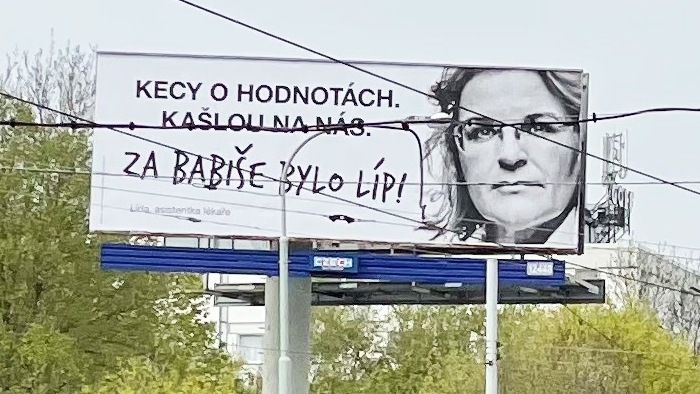
The material displays a politically charged visual in Czech, dominated by the face of a person and the striking slogan "IT WAS BETTER UNDER BABIS!". The black-and-white base is complemented by a red inscription that appears to be a handwritten transcription over the original poster, evoking an intervention into an already existing message. The slogans "TALK ABOUT VALUES. THEY DON'T CARE ABOUT US." also appear, along with a personal story element in the form of the label "Lída, doctor's assistant," which adds a personal dimension to the message. The composition emphasizes readability and the face, giving the visual an authoritative tone.
The analysis shows agreement in that the image works with emotional appeal, particularly nostalgia and dissatisfaction with the current state. The use of black-and-white tones with a red accent increases urgency, while the large face and clear typographic division maximize the impact of the message. The personal designation like "Lída, doctor's assistant" is intended to evoke identification and trust without offering verifiable data or broader context. The overall effect aims to increase attention and strengthen a simple evaluative framework without factual support.
There is also consensus that the message utilizes elements of emotional manipulation and polarization, with some parts of the text bearing the hallmarks of ad hominem attack ("Talk about values. They don't care about us."). The absence of context and the unclear identity of the author of the intervention in the poster are also noted, which weakens accountability for the claims. The visual trace of the handwritten transcription acts as a devaluation of the original material and shifts the message towards a protest vandalism gesture that replaces arguments with heightened framing. Assistants agree that the communication is strongly affective and does not offer factual solutions or data.
Regarding the origin of the image, automated detection indicates a reliability value of 0.01, which is very low and does not allow for conclusions about whether it is an AI-generated image. This metric is inconclusive and does not support a definitive verdict on the authenticity of the visual. The editorial perspective therefore primarily relies on content and formal analysis, rather than uncertain technical detection. From the available signs, it follows that the material is based on emotional appeal, rather than verifiable evidence.
Overall, the material represents political agitation relying on manipulative framing and subjective evaluation, with the slogan "It was better under Babiš" being an unverifiable claim and functioning as a slogan rather than a fact. The absence of a clear source and accountability, along with aggressive rhetoric, increases the risk of misleading interpretations and deepens polarization. In the context of electoral or protest campaigns, this is a common practice intended to mobilize emotions instead of rational debate. For the audience, this leads to the recommendation to view the message as a rhetorical appeal and to seek specific data and comparable metrics before accepting similar theses.