
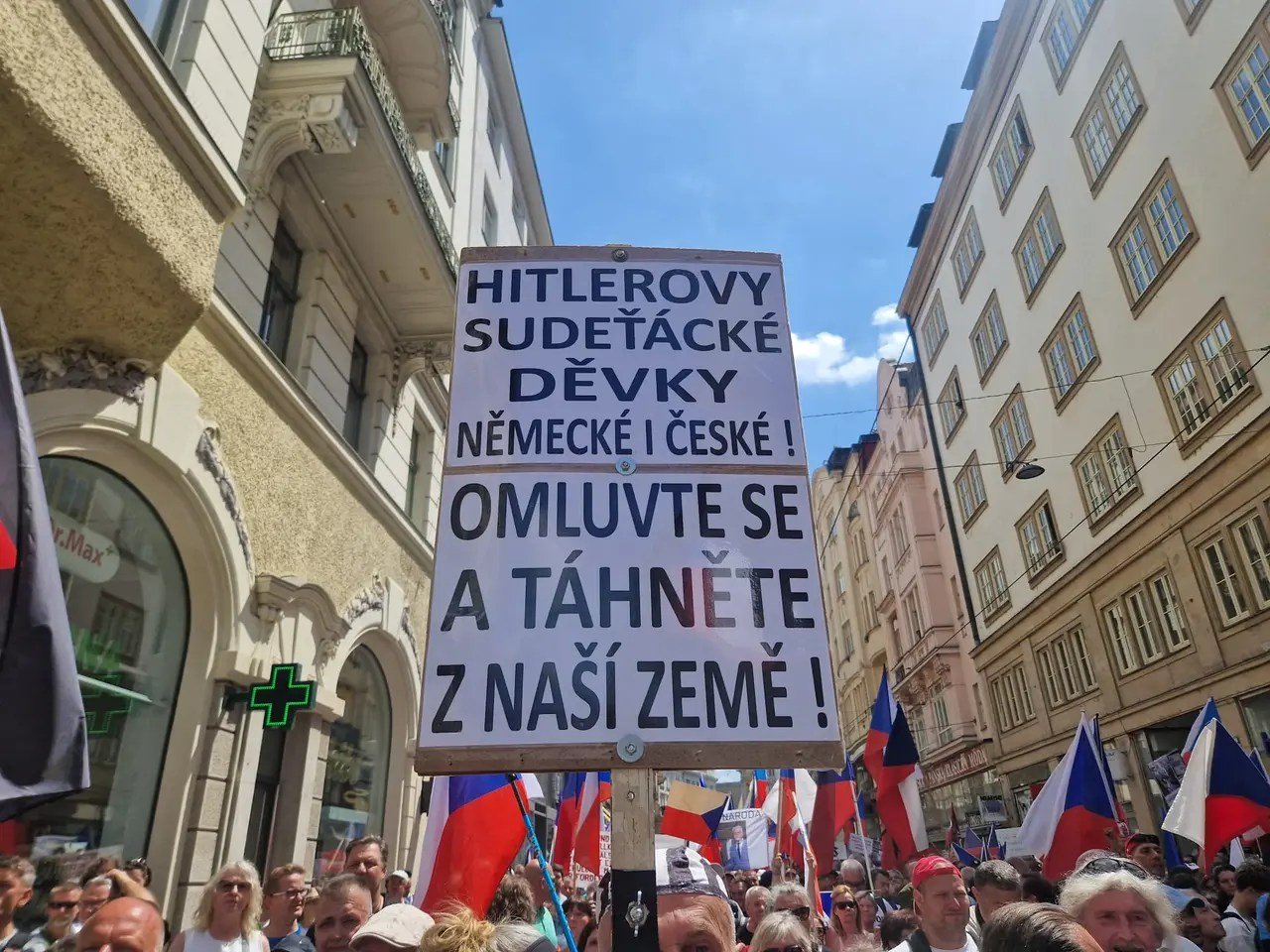
Omluvte se a táhněte z naší země
⚠️ OCR transcript failed.
🔒 OCR transcript is available in Standard, Mini, and Pro plans.
View pricingOriginál ()
Překlad ()
🏷️ Keywords
📝 Brief summary
✓ Verifiable claims ()
⚠️ Detected logical fallacies ()
🏷️ Keywords
📝 Brief summary
The photo shows a street demonstration with a large number of people and Czech flags. In the center, there is a large poster with text that attacks both Germans and Czechs, calling for an apology and leaving the country. The text of the poster contains offensive words and historical references to Hitler. The entire scene appears tense and promotes exclusion and a simplified division of 'us' and 'them'. The content of the poster is distinctly hateful and manipulative, not based on specific facts.
AI Analysis • 🤖 Fact Ninja - výchozí
The image captures a street demonstration with Czech flags and a dominant banner featuring aggressive, offensive text. The main intent of the message is to mobilize the crowd against a certain group, incite anger, and define itself against the "foreigners" with an appeal for their exclusion.
- Hateful and vulgar language: the use of harsh insults and dehumanization increases emotional tension instead of rational debate.
- Imperative and call for exclusion: commands like “Apologize and get out of our country!” are directive, push for obedience, and legitimize social exclusion.
- Guilt by association (reductio ad Hitlerum): reference to the Nazi leader aims to stigmatize opponents without substantive argumentation and instrumentalizes historical trauma.
- Generalization and labeling of groups: blanket labeling of various groups (e.g., “German and Czech”) is unfounded generalization that creates collective guilt.
- Polarization of “us vs. them”: phrases like “our country” build a sharp boundary between “us” and “them,” fostering antagonism.
- Emotionalization and appeal to resentment: evoking historical grievances serves to mobilize anger and fear, not to address specific issues.
- Visual dominance and garishness: large uppercase letters, contrasting black text on white, and a multitude of exclamation marks enhance the sense of urgency and authority of the message.
- Bandwagon effect: the presence of a crowd and flags can create the impression of widespread support, thereby pushing for conformity.
- Absence of factual basis: the message relies on insults and claims without evidence, lacking verifiable information or arguments.
- Ethical positives of the context: it is a clearly marked opinion of the demonstrators within a public gathering and transparently declared stance (not hidden advertising or a disguised campaign).
Overall, the banner predominantly employs manipulative and hateful techniques (vulgarization, calls for exclusion, stigmatization through historical associations). Assessment: highly manipulative.
Verify image origin
Like this analysis?
To like analyses, please sign in. Create a free account or log in to an existing one.
Likes are a paid feature
Liking analyses and following authors is available on paid plans. Start with the Mini plan.
- Like favorite analyses and revisit them
- Follow interesting authors
- Custom categories and groups